
The governor made it clear that the RBI is aware of what's happening and acts accordingly, but doesn't make a noise about that, points out Tamal Bandyopadhyay.

The bosses of SBI, Union Bank and Central Bank have been driving down to their offices everyday to take stock of the biggest loan drive ever undertaken for MSMEs, discovers Tamal Bandyopadhyay.

The main objective is to determine whether among these companies there are NBFCs that ought to have registered with the RBI for carrying on their NBFI activities.

A top-class board is important from a systemic point of view, more so at a time when the wider financial world and India Inc is chasing the same talent as banks.

The regulator has put a cap on the business a bank can get from a single insurer.
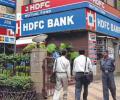
But there are challenges, observes Tamal Bandyopadhyay.

The Nifty Index features 50 of the largest companies in the country and represents close to 50 per cent of total market capitalisation. It is now trading at valuations that could only be justified if India Inc grows earnings at better than thrice the GDP growth rate. This is extremely unlikely, says Devangshu Datta.

Nearly three-fourths of the debt money, as of April 30, 2019, was invested in securities with duration of less than three years.

The first quarter of 2018 saw infrastructure and real estate drive investment worth close to $8 billion across 180 deals

Farmers have suffered a lot on account of natural calamities.

'Facilitating conversion of well-run NBFCs into banks is urgently needed.'

Since December 2018, monetary policy has been eased substantially by RBI with policy rates being cut by 75 bps and policy outlook being changed to 'accommodative'.
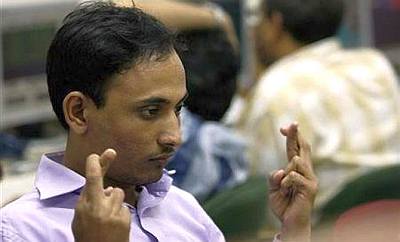
The recovery was led by information technology exporters.

According to sources, both the departments have already laid their claim on the proceeds from the sale of the property

There was no relief for existing home buyers who are stuck in stalled projects and are paying both rent and EMI on their home loans.

NSC scores high on all three parameters that conservative investors are seeking -- safety, tax-adjusted returns and liquidity.

On November 12, 2021, the Reserve Bank of India (RBI) decided to ring in uniformity in asset classification and income recognition across all lending institutions. Shadow banks, or non-banking financial companies (NBFCs), like commercial banks, are to test non-performing assets (NPAs) on a daily basis and upgrade them to "standard assets" only when interest and principal arrears are settled by borrowers. This is going to create all manner of headaches for shadow banks and their clientele. Says Y S Chakravarti, managing director and chief executive officer (CEO), Shriram City Union Finance: "NPA levels will go up, especially of small borrowers.

'The variables to watch include the monsoon, resolution of NBFC liquidity issues, GST collections, and NPA resolution.'

Co-founders of India's latest unicorn expected Covid-19 to be a speed breaker; instead it accelerated sales. Cars24 now enjoys more than 90 per cent market share among all other similar online transaction platforms. Dhruv Munjal traces the birth of this used-cars platform.

Significant portion of the funds used to fuel urban demand have become illegal and inoperative.

The third-quarter financials didn't excite market watchers. But equity investors can still make money if they invest in the right stocks.
"We will raise Rs 300 crore via bonds of two-, three- and five-year tenures. This will be our maiden bond issuance and is part of our effort to widen funding sources," says Vimal Bhandari, executive vice-chairman and chief executive officer (CEO), Arka Fincap. The firm, a subsidiary of Kirloskar Oil, is only five years old and small (assets of around Rs 5,000 crore with an "AA" rating), but the response to this float will be closely watched: It would be the first by a non-banking finance company (NBFC) after Mint Road upped the risk weights on bank exposures to them by 25 percentage points. The move by the Reserve Bank of India (RBI) has caught NBFCs off guard even though the issue had been flagged by Governor Shaktikanta Das with their corner-room occupants (and that of banks) in July and August 2023 - on consumer credit and the dependency on bank borrowings.

Its statement also said Facebook does not use WhatsApp payments information for commercial purposes.

Demand among several pre-Budget representation by BSE Brokers' forum
Since the bankcuptcy law came into effect from December 2016, with every quarter, the recovery rate has progressively been going down, notes Tamal Bandyopadhyay.

The government plans to bring down its stake to 26 per cent in these two banks, which are yet to be identified. This may not come in the way of getting investors for these banks, provided the government is willing to step back rather than run them the way it had been doing for over five decades since these banks were nationalised, points out Tamal Bandyopadhyay.
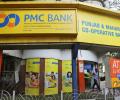
Mired in corruption, politics and with a history of suicides by its hapless depositors, PMC Bank's revival is a challenge very different from Yes Bank and LVB, both for the regulator and the rescuer, observes Tamal Bandyopadhyay.

For the first time, consumers, including those at the so-called bottom of the pyramid, are monetising gold by taking loans from banks, offering the yellow metal as collateral, says Tamal Bandyopadhyay.

The lockdown that crippled the entire logistics, delivery and supply chain network to near zero, was enough to deal a body blow to India's fastest growing unicorn whose very business model saw a severe disruption, like several other firms and sectors.

Gold prices fell to a 5-year low of less than $1,100/ounce.

Fitch reaffirmed India's rating at 'BBB-' with a Stable Outlook saying the rating balances a still strong medium-term growth outlook compared with similar category peers and relative external resilience stemming from solid foreign-reserve buffers against high public debt, a weak financial sector and some lagging structural factors, including governance indicators and GDP per capita.

'The probability of another negative year in 2019 is low.'

Historically, overall credit has grown at 1.6 times GDP growth
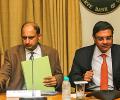
'Those who come from outside are surprised at the relatively small strength of the RBI supervisory cadre, relative to the needs of the country and the needs of the financial sector.'
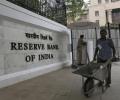
In all, RBI has cut interest rates by 110 bps this year. But this has not yet led to a boost in economic activity. While the growth rate has slowed to a five-year low, consumer confidence is waning and foreign direct investment has plateaued.

Digital services work best when the seller designs a system where default options are designed to help the buyer, says Debashis Basu.

How much will the banks' bad assets grow in March? It could be anywhere between Rs 1.2 trillion and Rs 2 trillion, observes Tamal Bandyopadhyay.

Only six sectors are likely to report good set of numbers in Q4 FY15.

A fall presents an opportunity to buy rate-sensitive stocks.

The first stage of the inclusion strategy was focussed on opening bank accounts, logically seen as creating the last-mile channels for financial access.
